Thursday, 28 July 2011

2- Singapore announces 5-year ICT vision

Assalamualaikum..

(3rd LAB) - ISSUE ON ICT - INTERNATIONAL SOURCES
The Singapore government announced its new e-Government Masterplan 2011–2015 (eGov2015) on 20 June 2011 at the eGov Global Exchange. Teo Chee Hean, Deputy Prime Minister and Minister for Home Affairs said during his keynote address that eGov2015 hopes to achieve an improved exchange of information and ideas; catalyse the development of new e-government services and delivery channels; and improve public service delivery.

This new plan will “build on the success of previous e-government plans”. The most recent of which, iGov2010, is lauded in the eGov2015 brochure as having helped Singaporeans embrace e-government with almost nine in 10 citizens expressing satisfaction with the quality of e-services in 2010, and more than nine in 10 citizens recommending others to transact online with the government.
eGov2015’s vision—To be a collaborative government that co-creates and connects with our people—will be realised through three frontiers:


  • Co-creating for greater value

  • The Singapore government will develop platforms on which the private sector can co-create with the government, offering new value-added services to the public. “Governments too can take a leaf from Apple’s successful App Store concept. Today, Apple does not design and build its applications in-house but provides the platform and tools for the highly talented and motivated developer community to create great applications for its customers.,” Teo said. “The Singapore government is already looking at how we can develop collaborative platforms that foster the creation of new ideas by tapping on the creativity and dynamism of innovative individuals and companies.”
    Hence, two new public services—Data.gov.sg for publicly available government data and mGov@SG a mobile portal with more than 40 mobile sites and apps—were launched on 20 June 2011.

  • Connecting for active participation

  • Recognising Singaporeans’ extensive use of social media, citizens will be invited to and informed of the latest government consultation topics via alerts sent through mobile and social media apps. New platforms such as crowdsourcing will be explored as a platform for engaging citizens. “Government agencies have also been looking at public feedback on other online platforms where netizens naturally congregate,” said Teo.

  • Catalysing whole-of-government transformation

  • To enhance cross-agency collaboration and to support new programmes that will be rolled out under eGov2015, the government will establish a private G-cloud that will offer shared services in a secure and multi-tenanted environment. 
     
    (http://www.futuregov.asia/articles/2011/jun/21/app-store-type-co-creation-part-new-singapore-egov/)
     
    By :
     
    Xinghui Guo

    Xinghui Guo

    Journalist
    Tel: +65 6324 7638
    Email: xinghui.guo@alphabet-media.com

    3- Issue for Region ICT 4D in Asia Pacific : An Overview Emerging Issues

    Assalamualaikum..

    (3rd LAB) - ISSUE ON ICT - INTERNATIONAL SOURCES

    In 2007, it cannot be denied that information and communication technologies (ICTs) have had a transformative impact on the entire Asia Pacific region. Even in the least developed areas of the region, where ICTs have yet to make a significant mark on everyday life, the processes of lawmaking and the flow of economic goods are in some way influenced by globalization and networked markets enabled by ICTs.
    As ICTs become central to the economic structure of countries all over the world, the approach to their role in social and economic development has become more sophisticated. In contrast to earlier policy agendas which sought to increase the use of ICTs as a pathway to achieving development, there is an increasing recognition that ICTs cannot be seen as inherently good or bad, as their effects are dependent upon the particular context of use. For example, access to e-commerce facilities may allow a producer to sell goods to an external market, resulting in higher sales. However, this same channel will allow the importation of goods and services which will pose a threat to local industry development.

    Therefore, the decision to enter a global electronic market is a strategic one: the success factors for local businesses and regions will depend to a large degree on access to e-business skills, marketing budgets and distribution capacity. Where these exist, there is the possibility of greatly enhanced economic prospects through e-commerce. Where they do not, it is likely that exposure to global markets will result in overwhelming competition. The early Internet dream that held e-commerce as the saviour of the artisan producer has not come to fruition, even though there have been well-promoted individual success stories. Instead, the rise of ICTs has brought unprecedented consolidation in markets.

    Globalization researcher Saskia Sassen explains that this is due to the separation of organizational functions enabled by ICTs: the distinctive way information technologies facilitate dispersal of routine activities and centralization of control activities explains the increasing dominance of cities in global economic activity (Sassen 1991). While there will always be success stories among the poor, there is no doubt that ICTs are, overall, increasing the gap between wealthy and poor businesses, countries and regions.
    Little of the policy literature on ICT for Development (ICT4D) explicitly considers these larger overall effects of ICTs. More commonly, ICT4D discussions share uncomfortable similarities with ICT analysis emerging from highly developed economies, such as:
    • a focus on new, 'revolutionary' technologies designed to make obsolete older structures and ways of working, with little assessment of the total costs of such a transformation;
    • limited discussion of risk or unintended consequences from ICT developments; and
    • an abstract theoretical model for economic development through technology that downplays cultural and social issues which are critical to individual project success in the ICT field.
    Throughout Asia Pacific, the theme of Universal Access drives ICT4D policy. Policy initiatives carry ambitious titles such as 'Computers for all' or 'One laptop per child'. These are worthy ideals but in the policy setting they become problematic as they are never finally achievable and they provide little guidance for the tough decision-making that is required to support the use of ICTs where basic poverty issues, such as access to food, water and basic health care, remain unsolved. Kerry McNamara (2003, p. 1) points out this significant gap in evaluation:
    Despite a proliferation of reports, initiatives and pilot projects in the past several years, we still have little rigorous knowledge about 'what works'. There are abundant 'success stories', but few of these have yet been subjected to detailed evaluation. There is a growing amount of data about the spread of ICTs in developing countries and the differential rates of that spread, but little hard evidence about the sustained impact of these ICTs on poverty reduction and economic growth in those countries.
    Given this unhappy trend, why should developing regions even consider expanding their investments in ICT? Would it not make more sense, as some advocate, to concentrate on traditional industries and means of development?

    Our view is that even though ICTs are making economic development more challenging for developing areas, ignoring ICTs will only lead to further exclusion from the circuits of power and economic prosperity which rely on these technologies. But the challenges for a truly inclusive information society remain substantial and there are no magic solutions to follow from increased levels of investment in ICTs. It remains the task of each business, government, NGO and individual to formulate a strategy of engagement that suits their particular situation. More importantly, given the very unstable nature of ICT-enabled markets and relationships, it is imperative to foster networks where we can learn from the experiences of others in similar situations, rather than accepting one-size-fits-all philosophies proposed by those benefiting from the status quo.

    Documenting and sharing these experiences is one of the key objectives of the Digital Review of Asia Pacific (DirAP). The thematic chapters in this issue, on Mobile and Wireless Technologies, Risk Communication, Localization, and Intellectual Property Regimes, highlight the wide range of options that are available for policymakers and ICT4D practitioners in these critical areas. The chapters on individual economies also highlight the diversity of ICT4D projects being undertaken throughout the region. In the rest of this chapter we outline the major trends in ICT as they affect human development—including technology, the knowledge economy, digital and economic divides, security, environment and e-Government. There is also an overview of the regulatory issues facing policymakers in Asia Pacific. After a brief look at the regulatory focus in developed ICT market countries, the chapter focuses on trends observed in developing ICT market countries and seeks to distil the key elements of regulatory approaches that have seemed to work, that have managed to encourage the growth of a healthy, competitive and innovative culture around ICTs. Our hope is that regulators and authorities in Asia Pacific can assess their own policy framing and implementation mechanisms against these measures and in cases where the measures are already adopted and part of the regulatory approach, there may be scope for a modified approach tailored to a country's culture and business environment.

    (Danny Butt, Rajesh Sreenivasan and Abhishek Singh)
    (http://www.digital-review.org/themes/5-issues-for-the-region-ict4d-in-asia-pacific-an-overview-of-emerging-issues.html)

    4- ICT Solutions benefitting India and Europe

    Assalamualaikum..

    (3rd LAB) - ISSUE ON ICT - INTERNATIONAL SOURCES

    ICT Solutions benefitting India and Europe


    Euro-India SPIRIT and SYNCHRONISER two EU-funded projects dedicated to synergising and strengthening EU-India relations in ICT research and innovation organised a joint ICT Policy Workshop on 10 November 2010 in India.
    Modern healthcare is becoming more and more reliant on Information and Communication Technologies (ICT) which offer a variety of benefits such as increased efficiency, a decrease in overall healthcare costs and improvements in patient safety. The growth of ICT solutions for healthcare is a global trend that is reflected in India, where the technology is seen as a key enabler in scaling up and managing networks of hospitals as the market for affordable healthcare in India grows. The social significance and possible implications of this is widespread and could reach underprivileged and rural sectors of Indian society for who affordable healthcare is often not yet a reality.
    The topic of ICT for healthcare and the broader issue of how ICT can address Societal Challenges were just two of the issues discussed at the Euro-India SPIRIT and Synchroniser ICT policy joint workshop held on 10 November at SurajKund Delhi NCR. The event enabled ICT experts and stakeholders from Europe and India to discuss and deliberate upon issues that have direct bearing on ICT policies formulated in the two regions. The insights that emerged outline a roadmap of thematic concerns for future collaborative research, and pronounce the strong need to engage the respective governments and industry practitioners in an active ICT policy dialogue.
    In the build up to the workshop an intensive meeting of Euro-India SPIRIT experts took place the day before focusing on shaping EU-Indian ICT policy in three main areas ICT Addressing Societal Challenges, AudioVisual Media and Internet, and Emerging Technologies and eInfrastructures. The group consolidated the findings and results of previous meetings to leverage joint cooperation between EU and India in areas that offer mutual benefits for both sides. Areas recommended for future collaborative research include: boosting e-Healthcare capacities; investing in secure and dependable ICT infrastructures; broadband research capacities pertinent to both EU and India; ICT applications in disaster management; e-Services like multi-lingual content and cloud computing; data acquisition, dissemination, storage and management; issues of security and trust; and empowering end users.
    Comprehensive discussions on policy measures to fund and promote research kept the experts’ discussions animated, as did the talks that stressed the importance of addressing a validation scenario right at the stage of formulating research proposals. The importance of adding local depth to a global infrastructure was also repeatedly highlighted during the course of the meeting.
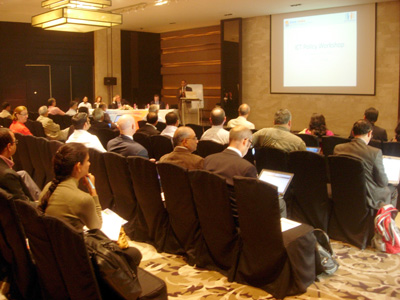
    Participants of the joint ICT Policy Workshop.
    Participants of the joint ICT Policy Workshop.
    The ICT joint Workshop itself welcomed over 50 participants including key stakeholders from the Indian Government, European Commission, academia, industry, civil society, researchers and practitioners discussed and reflected upon joint research possibilities in the domain of ICT for Development between the European Union (EU) and India. With a keynote presentation on Indian ICT Policy Issues from Dr. G Narendra Kumar, Joint Secretary Performance Management Division, Cabinet Secretariat, the exclusive invitation-only forum aimed to maximise the effects and benefits of policy dialoguing among stakeholders and experts from EU and India. Alvis Ancans, International Relations Officer, European Commission, highlighted the structure of FP7, including a breakdown of funding areas focusing on ICT; by outlining the various types of support that the European Union offers for international collaboration; and by listing the Indian organisations that have been successful so far in FP7 ICT Calls such as FICCI, IBM India, CDAC , EIRC and IIT Delhi and Bombay.
    Participants from elaborate discussions that dwelt upon how societal challenges in India could be applied to the Seventh Framework Program (FP7). They also took back home practical ways to transform research ideas into EU-funded projects.
    As an outcome of the two-day intensive exercise, Euro-India SPIRIT re-aligns its priority to drawing expertise and knowledge from the industry practitioners. This would allow real use case scenarios to be discussed, showcasing benefits and pinpointing real challenges on the ground.
    In the coming year SYNCHRONISER will publish and promote the long term research perspectives and trends study in India that has been identified by the Indian high level visionaries while Euro-India SPIRIT will issue a policy recommendations document from the experts findings.
    Both projects will actively participate in a series of ICT events to be hosted in India in 2011. Working Group experts will interact with stakeholders from the government, industry, academia and civil society on issues pertaining to ICT societal challenges in the country, technology application concerns, application of European research results, and ICT policy matters.
    The two projects will then consolidate the identified priority research themes between India and Europe to create an enduring collaborative R&D framework between the two regions. Policy recommendations will be submitted to the Ministry of Communications and Information Technology, Government of India and to the Directorate General for Information Society and Media, European Commission. The document will highlight themes for joint EU-India research collaborations and innovation in the field of ICT for development.


    (by Juanita Kakoty and Nicholas Ferguson)
    (http://ercim-news.ercim.eu/en84/jea/ict-solutions-benefitting-india-and-europe)

    Monday, 11 July 2011

    5- International Conference on ICT for Africa 2011

    Assalamualaikum..

    (3rd LAB) - ISSUE ON ICT - INTERNATIONAL SOURCES


    Theme: ICT For Development in Africa – Sustaining The Momentum, Extending The Reach

         Emphasis of current research on ICTs in Africa has been on creating awareness, identifying potentials and building capacity. The fact that current challenges relating to infrastructure, security and government policies can slow down the benefits accruable from a virile ICT growth has also been highlighted. Empirical evidences on ICT adoption and diffusion in Africa reveals an upward growth. This fact is supported by the rapid increase in mobile telephone subscribers, online banking, the proliferation of e-government portals and electronic commerce. Firm-level variables such as financial capacity and technological absorptive capacity have also influenced the intensity of the adoption of ICTs thereby suggesting that globalization has also influenced the adoption of new technologies in Africa. 

          Unfortunately, the developmental trend has concentrated in cities, metropolis and urban communities in Africa with millions still out of reach of the ICT development wave. This scenario raises two basic questions in the mind of ICT technocrats, practitioners and the academia. How can we sustain the present developmental momentum? What can be done to extend the reach of ICT to the unreached? There is an urgency to keep pace with ICT development and its benefits while also addressing possible areas of developmental benefit of ICT to other target groups. Rural dwellers, farmers, extension officers, health workers and social workers must be empowered to use and apply ICTs much more creatively and pragmatically to development problems beyond the internet-enabled PC telecenters. There is also the challenge of the non-involvement and imbalance of gender, dearth of sound ICT-roadmap and strategies by policy makers resulting in uncoordinated and unsustainable ICT-development activities.

           This conference will bring together a fine mix of practitioners and academicians in the area of ICTs for sustainable development. The conference will explore the possibilities of continuity in terms of contributions from Africa to the ICT for Development discourse as well as initiate pragmatic measures needed to extend the ICT reach. The objective is to highlight the synergy of collaboration between African countries and other developing countries, and between African countries and the developed countries towards development solutions. Discussions and panel debates will focus on what can be done to sustain the developmental pace and close the ICT gap still existent in Africa. Workshops will examine international grant-seeking opportunities for ICT research and projects, the menace of cybercrime as a limiting factor on ICT for development and e-learning for African universities and new frontiers in telemedicine. 
            
            In this respect, we highly appreciate your participation to enrich the diversity of perspectives and contents to be presented. We believe that your invaluable experience, insight and comments will add to what is potentially a very important discussion for developing nations.


    (Longe Olumide Babatope (PhD)
    Department of Computer Science
    University of Ibadan
    Ibadan
    Nigeria
    Email: longeolumide@icitd.org 
    Visit the website at http://www.ictforafrica.org)

    1- Malaysia wants more cooperation in ICT with Korea

    Assalamualaikum..

    (2nd LAB)


    SEOUL: Malaysia wants to have more cooperation in information communication technology (ICT) with South Korea, which is well ahead in ICT, to enhance their bilateral relations in the field which is currently still at a moderate level.
    Information Communications and Culture Minister Datuk Seri Dr Rais Yatim said Malaysia hoped the cooperation could be translated into ICT-related projects to strengthen diplomatic relations between the two countries, which are celebrating 50 years of that relations this year.
    He said Malaysia would try to venture into various areas of ICT where Korea had the strengths in implementing the projects.
    “We will see how Korea could advance and be the number one country in the ICT field and how it has incorporated ICT use in villages throughout the country, besides educating Korean youths on how to use ICT to generate income, especially in the content industry.
    “These are interesting areas and we will try to venture into some,” he told Malaysian journalists covering his attendance at the World Information and Communications Summit: WICS 2010, held in the South Korean capital.
    Rais said Korea also had an interesting programme in developing animation and research in three-dimensinal computer graphics, which were used in science fiction films such as the epic movie, Avatar.
    “These fields are very interesting and will give huge returns to both countries. We are actually looking at the Korean ICT as the champion in the industry as it has pioneered various advanced areas at the international level.
    “So, we need to learn how Korea managed to sell its animation, movie and cinematography culture and expertise outside the country,” he said.
    Rais said agencies involved in ICT in Malaysia should study the ICT developments in Korea and make proposals to the government on the approaches that could be taken to emulate Korea’s success.
    He said Malaysia-Korea cooperation in ICT could also be forged through ICT training programmes involving the Malaysian Communications and Multimedia Commission and the Korean Communications Commission, and between the ICT practitioners of both countries.
    “Perhaps there will be some of our ICT practitioners coming here and some from Korea going to Kuala Lumpur to see how the Malaysian ICT industry can develop in the best possible way.”
    Rais regarded the organising of the WISC, where the leaders, ministers and deputy ministers from nine countries including from Asia discussed and exchanged ideas in ICT, as a noble effort by Korea.
    “As an experienced country, Korea has further strengthened friendship with the developing countries, so that Asia as a whole will not lag behind in the field.
    “We (Malaysia) shall take this as a new beginning for us, in a new era where ICT is part of our lifestyle that bring us economic, cultural and industrial benefits,” he said.
    The two-day WICS 2010 organised by the Korean Multimedia Communications beginning Tuesday, was aimed at strengthening cooperation and building a sustainable future for the participating countries by sharing experiences and vision in ICT.
    Rais also said that Malaysia and Korea would discuss the possibility of coming up with a book on 50 years of Malaysia-Korea relations. --

    (
    Bernama )

    (
    http://thestar.com.my/news/story.asp?file=/2010/5/27/nation/20100527083922&sec=nation)

    2- MALAYSIA BANKS ON ICT TO MEET 2020 DEVELOPMENT GOALS

    Assalamualaikum..

    (2nd LAB)

    Malaysia’s Government CIO has hailed ICT as a “key enabler” to fulfil Prime Minister Datuk Seri Najib Razak’s mission to transform Malaysia into a developed nation by 2020. Speaking at the FutureGov Forum Malaysia in Kuala Lumpur on Tuesday (23rd February 2010), Dr Nor Aliah Zahri, Government CIO and Deputy Director General of the Malaysian Administration Modernisation & Planning Unit (MAMPU), said that the 2020 goal was a “reasonable target to attain”.


    “We acknowledge that we face significant challenges,” Dr Aliah told delegates. “But we are seeing positive change as Malaysia continues to transform into an information-centred economy by focusing on innovation, value and high skills.”
    Malaysia’s National Broadband Plan, which aims to see household broadband internet penetration rise from 26 per cent to 50 per cent by the end of this year (2010), will play a big part in connecting the country of 23 million people, Dr Aliah noted. If this target is met – Malaysia’sGDP, which has been sluggish during the global economic downturn, could grow by 1.2 per cent, she said.
    The Government Transformation Roadmap Plan, introduced this year to improve government services, will help keep the 2020 vision on track, Dr Aliah said. “This is a bold and unprecedented plan for every ministry to ensure that every citizen enjoys the fruits of a growing nation,” she said.
    Part of the plan is “Connected government”, an initiative launched in 2007 to boost information sharing, integration and interoperability among government agencies, and strengthen and unify ICT infrastructure. “We want to move towards zero face-to-face interaction for citizens for selected agencies as more services move online,” said Dr Aliah.
    Another strategy has been to focus on a few “high-impact projects” that will deliver immediate results. One of the most successful to date is MySMS, which gives Malaysians one number – 15888 - to text government with complaints or queries and receive news about new services. The service already has 1.4 million users.
    Similar in aim to MySMS is MyID, which enables Malaysians to use a single reference number when dealing with government agencies. Launched in January 2010, 760 services have been launched which use the MyID service to date.
    Dr Aliah explained that the progress of these projects, and the public sector as a whole, will be closely monitored by giving the highest performing agencies a “Public Sector Trust Mark” which citizens or businesses can use to gauge transparency.
    “If these initiatives are wholeheartedly embraced, the hope of the Malaysian government is that we will move towards a more systemic excellence culture,” she said.
    “Malaysia’s public sector will continue to transform to deliver higher performance to meet the 2020 goal. But we still need to change the way the civil service operates. E-government in Malaysia is well advanced, and it should be an integral component of a much broader mission to deliver the transformation agenda.”
    Malaysia was ranked 32nd in the United Nations E-Government Survey 2010 last month, moving up two places on its 2008 rank. Malaysia is the fifth highest placed Asian country in the rankings, behind Japan, Bahrain, Singapore and South Korea.
    FutureGov Forum Malaysia is an annual event organised by FutureGov magazine in close cooperation with the Malaysian government authorities.

    3- Malaysia looks to ICT to raise education standards

    Assalamualaikum..

    (2nd LAB)

    Malaysia’s Deputy Prime Minister has launched a new ICT policy to ensure better standards in ICT education in the country.

    Tan Sri Muhyiddin Yassin, who is also Malaysia’s Education Minister, spoke at the launch event of plans to implement the policy, which is intended to improve the quality of education in the country.

    The plan is that ICT will be used as the main teaching tool to encourage skills such as critical thinking and collaborative working.

    “The teaching and learning process is no longer a teacher centric or one-way process, said Muhyiddin. “ A teacher is now a classroom facilitator, who is equipped with ICT knowledge.”

    “Through this policy, all ICT programmes in the ministry will work towards the same goal, which is to increase student achievements and to ensure that every student has access to quality education.”

    The Deputy Prime Minister also added that Malaysia would be looking to those countries already using ICT in education to ensure the correct standards are reached, with the view to gaining the status of an advanced nation by 2020.


    (http://ictscoop.com/news/general-news/810-malaysia-looks-to-ict-to-raise-education-standards.html)

    Sunday, 10 July 2011

    4- Asean launches ICT Masterplan 2015

    Assalamualaiku..

    (2nd Lab )

    KUALA LUMPUR: The Association of Southeast Asian Nations (Asean) today launched a plan that will harness the potential of information and communication technology (ICT) in the region, to help in establishing an inclusive, vibrant and integrated Asean community.

    The Asean ICT Masterplan 2015 is comprehensive and has specific actions and projects with clear targets and timelines in six strategic thrusts to be implemented in the next five years.
    "It aims to deliver four key outcomes namely ICT as an engine of growth, recognition of Asean as global ICT hub, enhanced quality of life and contributions towards Asean integration," Information, Communications and Culture Minister Datuk Seri Dr Rais Yatim said.

    Speaking to reporters on the final day of the Asean Telecommunications and IT Ministers meeting in Kuala Lumpur today, he said: "We (Asean ministers) welcome and invite all relevant stakeholders and parties to support and actively contribute to the implementation of actions and measures embodies in the masterplan."

    Rais said the ministers have tasked their respective senior officials to review the existing ICT cooperation.
    These include amongst others the Asean e-commerce database, international mobile data roaming charges and interoperability framework in Asean projects.

    "The senior officials will also need to identify available funding sources to come up with the recommendations to ensure timely implementation of the masterplan for consideration at the ministers next meeting," he said.


    By Azlan Abu Bakar
    alan@nstp.com.my


    Read more: Asean launches ICT Masterplan 2015 http://www.nst.com.my/nst/articles/AseanlaunchesICTMasterplan2015/Article/#ixzz1RhEqQlzI

    5- Using ICT to compete in the global economy

    Assalamualaikum.. 


    ( 2nd LAB )

    KUALA LUMPUR: Local businesses must make use of the latest information and communication technology (ICT) solutions to enhance their productivity and to compete in the global economy, said SME Corp Malaysia CEO Datuk Hafsah Hashim.
    She said one of the criteria for developed countries was that small and medium enterprises (SMEs) should contribute to at least 40% of the gross domestic product (GDP), but local SMEs currently contributed 31% to GDP.


    “This means that SMEs have to grow 1% or more per annum to reach the desired 40% by 2020 (the year Malaysia aims to achieve a developed-nation status). We need a leapfrog growth driven by innovation 
    and productivity,” she said at the launch of Microsoft's Office 365 cloud computing service.
    The launch marked the beginning of a private-public partnership between SME Corp and Microsoft Malaysia to enhance the take-up of cloud computing among Malaysian businesses.
    Office 365 is Microsoft's newest ICT solution that utilises cloud computing to integrate business function over four primary products - office, sharepoint online, exchange online, and lync online.
    “SME Corp and Microsoft will also promote the cloud service through joint roadshows as well as a Microsoft booth in SME Corp's new one-stop referral centre in KL Sentral,” Microsoft Malaysia managing director Ananth Lazarus told StarBiz.
    Hafsah also said SME Corp would use the SME Competitiveness Rating for Enhancement (Score) programme to evaluate the ICT effectiveness of SMEs. SME Corp will take the lead in adopting cloud computing by using Office 365 in their KL Sentral office.

     By JOHN LOH
    johnloh@thestar.com.my


    Thursday, 7 July 2011

                                                                   [ Bismillahirrahmannirrahim ]      

    Assalamualaikum..


    Dear Readers


    Ha!! don't be surprise who in this picture!! hehehe..

    For all readers information , this is my Lecture subject for Information Technology (IT) / MGT 300. His name is Tuan Syed Mazlan Bin Syed Mad Dom . :D


    As we know before we start to learn something, we have to know who is our Teacher ! Am i right ?

    I think if only put a picture and his name , it is enough to clearly knows about him. Hehehe.

     Ok.. Come we go through about our main topic that is MGT 300 / Information Technology.

    What is actually IT ?

    Advantages ? Disadvantages ? Roles? Important? The Steps in IT ?

    All of this i will story in another post with the Assignment that are given. :D

    I hope we can wait for all of this !

    The End .

    Assalamualaikum. .. . . .
    Assalamualaikum  ,


    Dear readers ^.^, 


    Before i start my blogs with another things, better is let you all know about me ^.^ 


    Hehehe..

    1. My name is MOHAMAD IZZAT BIN ABD TALIB . 


    2. I was born in year of 1991 with the month of May and 26 Days ( 26 /05 /1991 ).  hehehe..


    3. Stayed and born in JOHOR BAHRU , SKUDAI ---> TAMAN UNIVERSITI ! ( UNIVERSITI ) 

        HEHEHE..  


     4. Stayed with my Mother , Brother and little sister . My father was died in years of 2004 :( (Tsunami 
          Event). 


    5.I have 4 siblings and i third (3rd). 

    6. I'm love to be simple. Not to complicated but sometimes i will if it for a task or jobs to settle it perfectly.
        I like to learn from people and myself mistake to make my self be more knowledgeable , experience , 

        Quality, and Perfectly ! ( If ALLAH wills ! ) :)

    7. Love to eat Nasi Goreng, Chicken Chop, Satay, Kurma ( Done Done je ) ..


    8. I love to have more friends !

    9. Better i stop here ! if not , this keyboard will be crash because i will make it damnly crush !! hehee.. there are a lot of story to tell.

    better i stop with Tasbih Kifarah and Surah 'Asr ........ ^,^ 


    Assalamualaikum ... May ALLAH bless ALL MUSLIM !